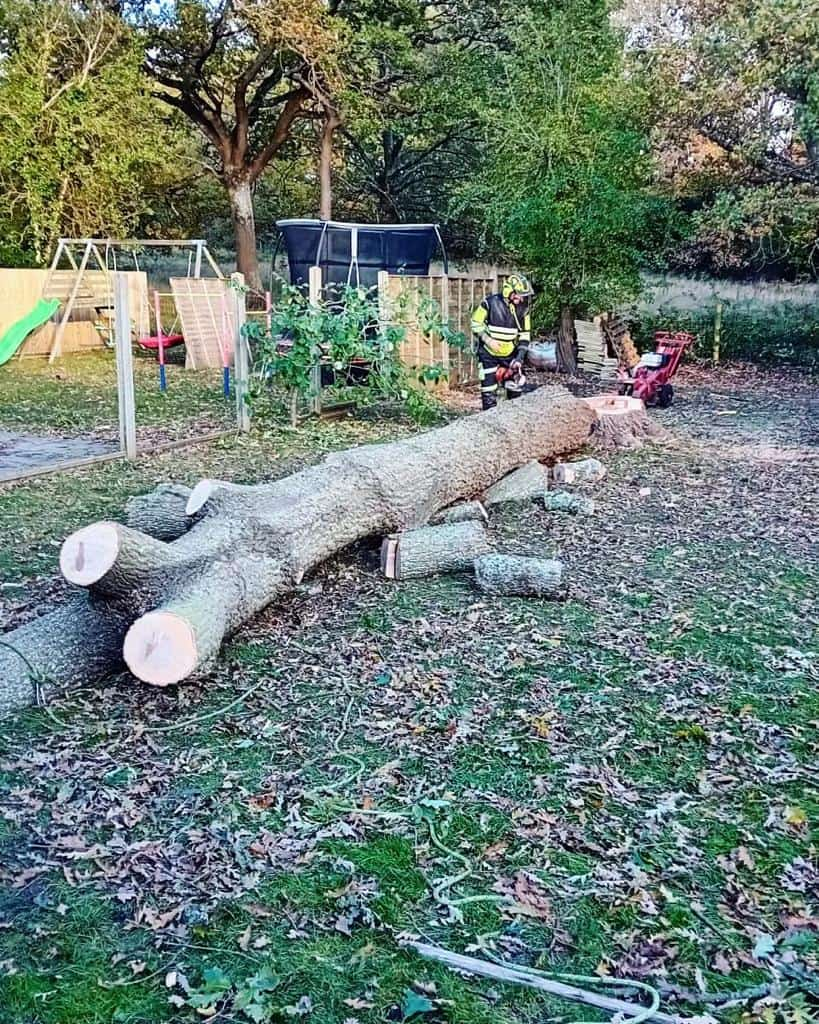
Stump grinding is suitable for many unwanted tree stumps, including large examples and those located in restricted parts of a garden. However, the work must be planned around the stump’s size, species, position and the available access.
For property owners in Newport, Essex, a professional assessment can establish which machine is appropriate, how the working area should be prepared and whether nearby features require additional protection.
How Professionals Approach Large and Inaccessible Stumps
Stump grinding uses a rotating cutting wheel to reduce the stump into small wood fragments. The process removes the visible obstruction and can continue below ground level, allowing the area to be reinstated for another use.
Large Stumps Can Usually Be Ground
A large stump may take longer to process because it contains more timber and may have a substantial root flare. Its size does not automatically make grinding unsuitable.
Professional machinery can remove the stump progressively, working across its surface in controlled sections. Exposed buttress roots around the base may also need grinding so that the surrounding ground can be levelled properly.
Narrow Access Does Not Always Prevent the Work
Stumps in rear gardens are often reached through side passages, gateways or other restricted routes. Stump grinders are available in different sizes, including compact machines designed for narrower access.
Before arranging the work, the access route should be measured at its narrowest point. Doorways, gates, steps, tight turns and changes in ground level can all influence which machine can reach the stump.
The Stump’s Position Must Be Assessed
A stump close to a wall, fence, shed, patio or planting bed requires careful handling. The grinder needs enough working space for the cutting head to move safely across the timber.
Nearby surfaces may need to be protected from flying fragments. Where the stump sits extremely close to a fixed structure, the operator may need to adjust the working method or accept that a small amount of timber cannot be reached without disturbing the surrounding feature.
Sloping and Uneven Ground Can Affect Access
A machine must remain stable while the cutting wheel is operating. Steep slopes, soft ground and uneven surfaces may make it difficult to position the grinder correctly.
A tree surgeon can assess whether the machine can approach from another direction or whether ground protection is needed. The route must support the equipment as well as provide sufficient width.
Stump Height Influences the Preparation
A tall stump contains more timber than one cut close to ground level. Reducing excessive height before grinding may make the process more efficient and improve access to the main stump base.
The remaining height, diameter and shape should therefore be assessed before the appropriate machinery and method are selected.
Tree Species Can Affect the Work
Wood density and root structure vary between tree species. Some stumps grind relatively easily, while dense timber or extensive root flares can require a more methodical approach.
The species may also affect the likelihood of regrowth from remaining roots. Grinding removes the main stump but does not normally remove the entire underground root system.
The Required Grinding Depth Matters
The intended use of the area should be explained before the work begins. A stump beneath a future lawn may require a different grinding depth from one occupying the site of a new patio, path or planting bed.
Grinding depth can influence how much material needs to be removed and how the space should be reinstated. For hard landscaping, the ground must still be prepared according to the requirements of the proposed surface.
Wider Roots May Remain Underground
Stump grinding focuses on the stump and its immediate base. Large roots extending through the garden are usually left underground to decompose naturally unless they create a specific obstruction.
Visible surface roots can sometimes be ground where access allows. If roots interfere with planned excavation or nearby surfaces, they should be assessed as part of the wider project.
Hidden Obstacles Can Complicate Grinding
Stumps can contain embedded stones, old fixings or other hidden materials. The surrounding ground may also include irrigation components, drainage features or buried obstructions.
Clearing loose debris from the area and sharing any known site information helps the tree surgeon plan the work. The stump should still be examined carefully as grinding progresses.
Restricted Sites Require Careful Debris Control
The cutting process produces wood fragments and disturbed soil. On an open site, containing this material is relatively straightforward. In a confined garden, nearby windows, paving, plants and garden features may require additional protection.
A professional operator controls the working zone and positions appropriate barriers where necessary. This helps keep the work focused around the stump.
What Happens to the Grindings?
Grinding creates a mixture of wood fragments and soil. Some of this material may be suitable for use as mulch, while excess material may need to be removed from the stump cavity.
If the area will become lawn or hard landscaping, it should be filled with material appropriate for that purpose. Grindings alone may settle as they decompose and are not always suitable as the main fill.
When an Alternative Method May Be Considered
Grinding may not be appropriate when machinery cannot reach the stump, the ground cannot support safe operation or the required removal involves more of the root system than grinding can provide.
In these cases, excavation or a modified landscaping plan may be considered. The preferred approach should be based on the site conditions and intended use of the area rather than the stump’s size alone.
Information Needed Before the Visit
Useful details include:
- the stump’s approximate width and height
- photographs showing the stump and surrounding space
- the narrowest access measurement
- steps, slopes and tight corners along the route
- nearby walls, paving and garden structures
- the intended use of the area afterwards
- any visible surface roots
This information helps determine which equipment may be suitable, although an on-site assessment may still be necessary.
Conclusion
Stump grinding is often suitable for large and difficult-to-reach stumps. Compact machinery can access many confined gardens, while more powerful equipment can process substantial stump bases in controlled sections.
The final approach depends on access, ground conditions, nearby features and the required grinding depth. If you have a difficult stump in Newport, Essex, Newport Tree Surgeons can assess the site and recommend an appropriate removal method. Contact the team to arrange a professional stump assessment.
Call us on: 01799 610 371
Click here to find out more about Newport Tree Surgeons
Click here to complete our contact form and see how we can help with your tree care needs.