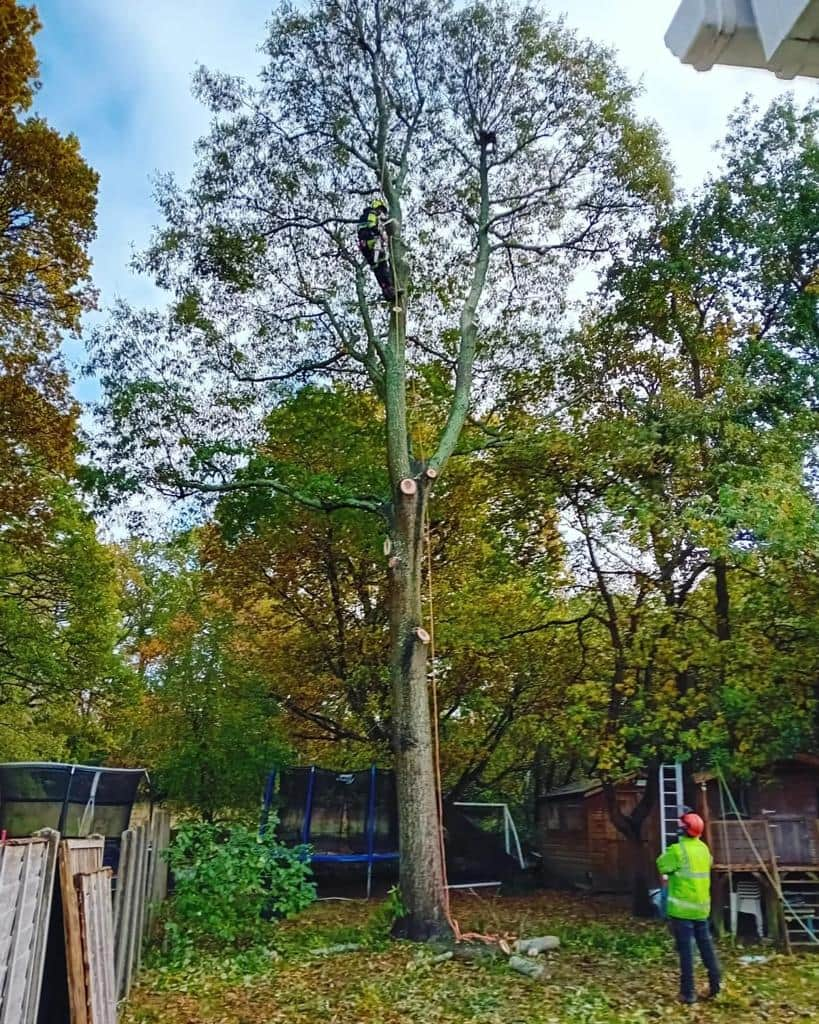
Trees growing close to the edge of a garden can sometimes develop branches into surprisingly confined spaces. A narrow gap between a house and fence is a common example. As branches lengthen and thicken, they may begin occupying the available space, brushing against nearby surfaces, restricting access or creating a dense area that becomes increasingly difficult to manage.
The solution is not necessarily to remove the tree or cut back the entire crown. In many situations, professional tree surgery can selectively manage the branches responsible for the problem while retaining healthy growth elsewhere. The key is to consider where the branches originate, how they are likely to continue developing and how much pruning is genuinely required.
For homeowners in Newport, Essex, dealing with this type of growth before the space becomes severely congested can make future tree management considerably more straightforward. A professional assessment can determine whether selective pruning, crown reduction or another targeted approach is appropriate.
How Can Tree Branches Growing Between a House and Fence Be Managed?
Branches growing within a confined gap can often be managed through selective pruning. Individual limbs can be shortened or removed where appropriate, creating greater separation while avoiding unnecessary work elsewhere in the crown.
However, the correct approach depends on the tree.
Simply cutting every branch back to the edge of the available space can leave poor pruning points and may encourage awkward future regrowth. Instead, branches should be considered according to their structure, attachment and position within the wider canopy.
The objective is to create useful clearance while retaining a balanced and appropriate crown.
Why Do Branches Grow Into Narrow Spaces?
Trees do not shape their crowns according to garden boundaries.
Branches develop in response to the tree’s natural growth habit, available light and surrounding conditions. If there is sufficient space for shoots to extend between a building and fence, that part of the crown may gradually occupy it.
What begins as relatively thin growth can become much more noticeable over several growing seasons.
This is why early management can be useful. Smaller, younger branches may provide more options for selective pruning than mature limbs that have already become major parts of the crown.
The Amount of Available Space Matters
Not every branch growing between a house and fence creates the same problem.
A wide gap may comfortably accommodate some growth, while a narrow passage can quickly become congested.
Before pruning, it is useful to consider how the space needs to function. If it provides regular access through the garden, greater clearance may be desirable than in an area that is rarely used.
Tree surgery can then be planned around the practical requirement rather than simply removing branches because they happen to extend into the gap.
Selective Pruning Can Target the Problem Area
Where only one section of the crown is causing difficulty, selective pruning can often provide a focused solution.
Individual branches can be assessed and shortened to appropriate growth points where suitable. In other cases, removing a particular branch may produce a better long-term result than repeatedly cutting its outer growth.
This approach allows unaffected parts of the canopy to remain largely unchanged.
For a healthy tree that otherwise fits comfortably within the garden, targeted pruning can therefore be preferable to carrying out unnecessary work across the complete crown.
Branches Should Be Cut Back to Suitable Growth Points
Where a branch needs shortening, the position of the pruning cut matters.
Simply cutting a limb wherever it reaches the desired boundary can leave an inappropriate stub.
Professional pruning considers the structure of the branch and identifies suitable points from which the remaining growth can continue.
This helps create a more natural result and makes the work part of a considered tree management approach rather than simply trimming the tree to an artificial line.
Creating Clearance Is Not About Cutting the Tree Flat
When branches extend towards a house or fence, it can be tempting to cut the side of the crown into a completely flat vertical face.
Trees do not naturally grow in this way.
Although some selective pruning may create greater clearance, the remaining crown should still reflect an appropriate natural structure.
Good tree surgery aims to balance practical space requirements with the way the tree grows.
This usually produces a better result than repeatedly cutting every shoot back to exactly the same boundary.
Younger Branches Can Be Easier to Manage
A branch that is currently relatively small can become considerably larger as the tree develops.
Its diameter increases, its secondary branches expand and it can become an increasingly important part of the canopy.
Addressing unsuitable growth while branches are younger can sometimes allow more selective management.
This does not mean every small branch heading towards a confined area needs immediate removal. It means that the likely direction of future growth should be considered before the space becomes dominated by mature limbs.
Mature Branches Require More Careful Consideration
If a substantial limb already occupies the gap between the house and fence, the decision becomes more significant.
Removing a major branch can alter the shape and distribution of the crown.
The branch attachment, size, position and contribution to the overall canopy should therefore be assessed before work begins.
In some circumstances, shortening the branch may be more appropriate than complete removal. In others, removal may provide the more sensible long-term result.
The decision should be based on the individual tree rather than convenience alone.
Repeatedly Cutting the Same Branches May Not Solve the Problem
Some homeowners find themselves cutting back the same growth every year because branches repeatedly return to the narrow space.
This can indicate that the pruning strategy is addressing only the latest shoots rather than considering the structure from which they originate.
Repeated tip pruning may produce increasingly dense growth around previous cutting points.
A more considered assessment can identify whether certain branches should be reduced further back or whether another pruning approach would provide a more manageable structure.
Future Regrowth Should Be Planned For
Pruning does not stop a tree from growing.
After branches are shortened, new growth will continue developing from the remaining crown. The amount and pattern of regrowth depend partly on the species and the extent of pruning.
This is why future development should form part of the original decision.
A pruning plan should not only create clearance on the day the work is completed. It should consider how the tree is likely to occupy the space as growth resumes.
Heavy Pruning Can Encourage Vigorous Regrowth
Removing more growth than necessary does not always provide a longer-lasting result.
Some trees respond strongly to heavy pruning by producing vigorous new shoots.
These shoots can quickly begin occupying the same confined space again, potentially creating a denser maintenance problem.
A proportionate approach can therefore be more effective.
Professional tree surgery aims to remove enough growth to achieve the required clearance while avoiding unnecessary disruption to healthy parts of the canopy.
Crown Reduction May Help When the Problem Is More Widespread
Selective pruning is useful when the difficulty is confined to particular branches.
However, if the complete side of a large crown has become excessive, crown reduction may sometimes be considered.
Crown reduction selectively decreases the dimensions of the canopy while retaining an appropriate branch framework.
It can reduce the spread of the tree and make an oversized crown easier to accommodate.
Whether this is suitable depends on the species, condition and structure of the tree, as well as how much reduction is actually required.
One-Sided Pruning Needs Careful Planning
When the problem exists entirely on the side facing a house or fence, it may seem logical to remove substantial growth only from that side.
However, heavily pruning one section while leaving the remainder unchanged can significantly alter the appearance and structure of the crown.
This does not mean one-sided pruning should never be carried out.
It means the wider tree should be considered while managing the affected section.
The objective is to achieve useful clearance without creating an unnecessarily awkward canopy.
Low Branches May Need a Different Approach
Sometimes the difficulty is primarily caused by lower branches extending through a narrow access route.
In these circumstances, selective removal or crown lifting may be more relevant than reducing the whole tree.
Crown lifting involves increasing clearance beneath the canopy by removing or shortening appropriate lower growth.
Where suitable, this can improve access while leaving much of the upper crown unchanged.
The amount of lifting should still be proportionate to the tree’s natural form and structure.
Dead or Damaged Branches Should Be Identified at the Same Time
When a tree is being assessed for clearance pruning, it makes sense to consider the condition of the relevant branches as well.
Deadwood, cracked limbs or previously damaged growth may already be present within the confined area.
These branches present a different consideration from healthy growth that is simply inconveniently positioned.
Professional assessment allows condition and clearance to be considered together so that the pruning work has a clear purpose.
Branches Touching a House Deserve Attention
As branches grow towards a property, smaller twigs and foliage may begin making repeated contact with nearby surfaces.
Rather than simply cutting the visible tips each time they reach the building, it can be more useful to consider which branches are directing growth into that area.
Selective pruning can then create appropriate separation while retaining the rest of the canopy.
The amount of clearance required will depend on the tree’s growth habit and how quickly the affected branches are likely to extend again.
Branches Around a Fence Can Become Difficult to Access
A branch that grows across or immediately beside a fence can become increasingly awkward as it thickens.
Secondary shoots may grow through gaps or develop on both sides, making straightforward pruning more difficult later.
Early assessment can identify growth that is likely to create a recurring maintenance problem.
Where appropriate, selective pruning can simplify the crown before the branch becomes substantially larger.
Dense Growth Can Restrict Access
The narrow area between a house and fence may be needed for routine garden access.
As branches and shoots gradually occupy the gap, moving through the area can become increasingly inconvenient.
Targeted pruning can restore usable clearance without automatically requiring substantial changes to the rest of the tree.
Where access is the primary objective, explaining this clearly during the assessment helps ensure that the pruning work focuses on the height and width of clearance actually needed.
Avoid Removing Healthy Growth Without a Clear Reason
A confined garden can make any nearby tree appear too large.
However, this does not mean all branches on that side should be removed.
Healthy, appropriately positioned growth contributes to the natural form of the tree.
Removing it unnecessarily can alter the canopy without providing additional practical benefit.
Each branch should therefore have a reason for being pruned, whether that is improving clearance, managing excessive spread, addressing damage or supporting a broader crown-management objective.
Tree Species Influences the Best Pruning Approach
Different tree species respond differently to pruning.
Their natural crown forms, growth rates and responses to branch removal vary.
A method that produces an appropriate result for one species may be unsuitable for another.
Professional assessment takes these characteristics into account before determining how far branches should be reduced and which growth should remain.
This is particularly important where ongoing regrowth into a confined area is one of the homeowner’s main concerns.
Previous Pruning Can Affect the Current Problem
Branches growing densely between a house and fence may sometimes have been cut previously.
Repeated pruning can influence how subsequent shoots develop.
Several new shoots may emerge around an old pruning point, creating a denser area than before.
Examining previous cuts can therefore help explain why the current growth has developed.
Rather than repeating the same approach, the new pruning plan can consider how the branch structure might be managed more effectively.
Should the Complete Tree Be Removed?
Branches growing within a narrow space do not automatically mean the tree needs to be felled.
If the tree remains suitable for retention and the problem is limited to one section of the crown, targeted pruning may provide a practical solution.
Felling represents a much more substantial intervention and should not be treated as the default response to inconvenient branch growth.
The wider condition and suitability of the tree should be considered before deciding whether removal is genuinely necessary.
What If the Tree Keeps Outgrowing the Available Space?
Some trees naturally develop large crowns and can require ongoing management where they grow within relatively confined gardens.
If pruning repeatedly provides only a short-lived improvement, it can be useful to consider the longer-term relationship between the tree and available space.
Questions worth considering include:
- Which branches repeatedly cause the problem?
- Is the difficulty limited to one section of the crown?
- How quickly does the tree regrow after pruning?
- Would selective branch removal provide a better result?
- Could crown reduction create more manageable dimensions?
- Is low growth the main problem?
- Is the tree otherwise suitable for retention?
Answering these questions helps determine whether periodic tree surgery offers a practical long-term management strategy.
Why Professional Tree Surgery Matters in Confined Spaces
Pruning between a building and fence can be more complicated than working on branches growing into open garden space.
There may be limited room around the tree, restricted access and very little space beneath individual branches.
Professional tree surgery allows the work to be planned around these constraints while also considering the tree’s structure.
The objective is not simply to remove whatever growth is closest to the property. It is to create useful clearance through carefully selected pruning while retaining a suitable crown.
Early Management Can Prevent the Space Becoming Heavily Congested
Tree growth is often easier to manage before substantial branches have completely occupied a narrow gap.
Early attention provides an opportunity to identify the direction of developing growth and determine whether selective pruning would be useful.
This does not mean continually cutting a tree simply to keep it small.
It means recognising where growth is becoming incompatible with the available space and managing appropriate branches before the problem becomes considerably more difficult.
Tree Surgery in Newport, Essex
At Newport Tree Surgeons, we assess trees according to their individual structure, condition and relationship with the surrounding garden.
Where branches are growing within a confined space between a house and fence, we can determine whether selective pruning, crown reduction, crown lifting or another proportionate approach would provide appropriate clearance.
For homeowners in Newport, Essex, the aim is to manage the branches responsible for the problem while retaining healthy, well-positioned growth wherever possible.
Conclusion
Branches growing between a house and fence can often be managed without heavily reducing or removing the complete tree. Selective pruning can target individual problem branches, while crown reduction or crown lifting may be appropriate where the issue affects a larger part of the canopy.
The best approach depends on the tree’s species, branch structure, condition, available space and likely future growth. Simply cutting every branch back to the boundary may provide only temporary improvement and can result in repeated, increasingly awkward regrowth.
If branches are beginning to dominate the space between your house and fence in Newport, Essex, contact Newport Tree Surgeons to arrange a professional assessment. We can identify the most appropriate pruning approach and help manage the tree in a way that provides practical clearance without unnecessary work.
Call us on: 01799 610 371
Click here to find out more about Newport Tree Surgeons
Click here to complete our contact form and see how we can help with your tree care needs.